
Meet the clients
The following personal stories from microfinance clients around the world illustrate the different ways in which people have used microfinance to transform their lives as well as the wider impact access to financial services has had on their families and wider communities. Many thanks to Five Talents, Opportunity International UK and Jamii Bora Trust for sharing these stories.
Besta - Malawi
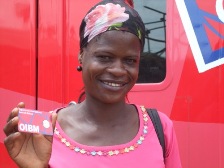 Besta is saving for her children’s education but because there isn’t a bank in her community, she used to have to travel a costly 90 kms to make a deposit. Her only alternative was to hide her precious savings at home.
Opportunity International’s mobile bank, an armored ‘bank-on-wheels’, started making weekly visits to her community in northern Malawi offering basic financial services. Because Opportunity uses ground-breaking biometric technology in the form of fingerprint data stored on clients’ bank cards, it didn’t matter that Besta doesn’t own any personal identification, something which had prevented her from opening a savings account before.
Thanks to her fingerprint-enabled bank card, and the bank coming to her doorstep, she can keep her precious savings safe at the bank. “My Opportunity card is very important to me, I am the only one who can access my account – no-one can steal my savings,” she says.
Jennifer - Uganda
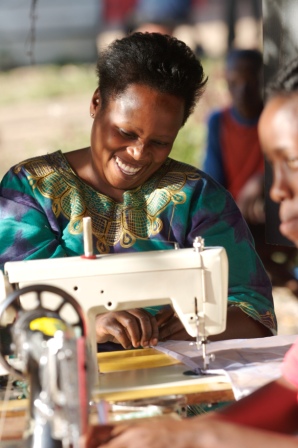 Jennifer worked hard as a seamstress in Uganda but struggled to make ends meet. She took out an Opportunity International loan to buy a sewing machine, and her business began to grow.
This enabled her to expand her sewing business, which in turn led her to gradually diversify into other areas. First, she opened a motorcycle taxi business, before purchasing land to build properties to rent out. Today, Jennifer’s combined businesses employ local people, and, besides her own children, she cares for five adopted AIDS orphans.
Lucas - Mozambique
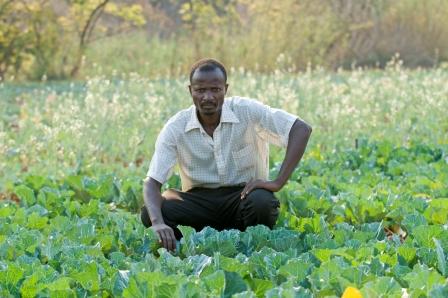 Lucas remembers how the civil war prevented his community from leaving the safety of the village to cultivate the surrounding land. "During the war I couldn’t implement anything," he recalls. But things have changed now. Today, with Opportunity International’s help, he’s reaping a harvest.
Lucas’s two-acre plot produces cabbages, onions and tomatoes. Not only is it safe to farm but Opportunity's mobile bank is bringing financial services to people in his community. It is making a tremendous difference. Before, a trip to the bank meant a costly 45km trek to Chimoio - the nearest town.
“Before Opportunity’s mobile bank came, people here would save money either by putting it in a pot or hiding it in the ground. But if you die, no-one knows where you’ve hidden the money…It’s best to keep savings in the bank.”
Lucas’s loans from Opportunity have allowed him to increase his crop, invest in chickens and buy a small pump to irrigate his field from a nearby stream. Now his children are in school and he is supporting two brothers though university. He also employs four people.
Joseph - Malawi
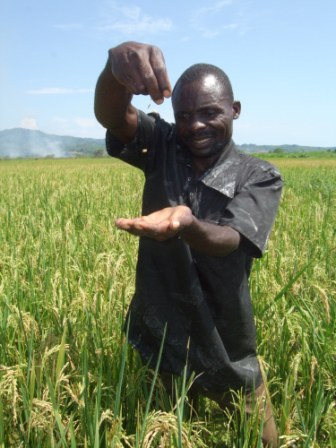 A rice farmer, and father of five, Joseph has taken out two Opportunity International loans. He has invested the money in fertilisers and a bulk order of beans to sell at the local market. He has also opened a savings account for the first time. “I don’t have a passport or identification so there was no way I could open an account at another bank,” he explains.
“Opportunity has taught me how to take better care of my family, how to save and that we should always have a vision when doing business,” he shares enthusiastically.
“My vision is to have electricity so that I can buy a fridge,” he says, confidently.
“With my disabled leg, I might find it harder to walk and work as I get older. If I have a fridge, I will be able to serve cold drinks in the community.”
Chris Chumpitaz - ECLOF, Peru
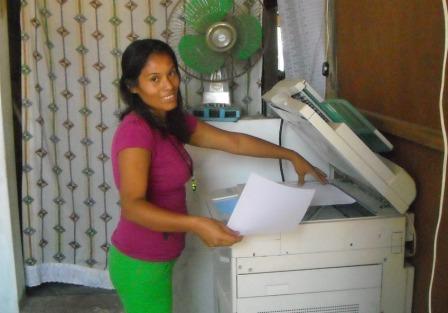 Born into a family of 14 children and the only daughter, Chris Chumpitaz understood economic depravation from a young age. When her own daughter, Cielo, was born when she was just sixteen years old. Chris faced the turmoil of supporting her child alone, without the help of her baby’s father, further burdened by her parents’ anger at having had a baby.
Chris joined the savings group ‘Las Hijas Del Rey’ (Daughters of the King), after working for two years at a clothing shop. Chris used the money she had earned at the clothing shop to buy a single washing machine and had started her own laundromat service. She later took out a loan of 300 soles (about £70) from Five Talents’ partner ECLOF Peru in order to buy a second washing machine and proceeded to further her business by selling Diclass products.
Chris recognised that finances alone weren’t sufficient for human development, and worked to improve relationships with the father of her first child and her family. Chris tapped into her entrepreneurial spirit through utilising ECLOF Peru’s loan programme and also took advantage of the spiritual and emotional support that she gained from being part of the group.
Today, Chris has a new boyfriend and a second child name Jhojdan. She has changed business and now has a printing shop where she offers photocopying and printing services. Her goal is to own a bookstore and is confident that she will be able to achieve her goals through the loans she receives through ECLOF Peru and the confidence that flourished through her membership to ‘La Hijas Del Rey’.
Mrs Theodora – GERHATI, Indonesia
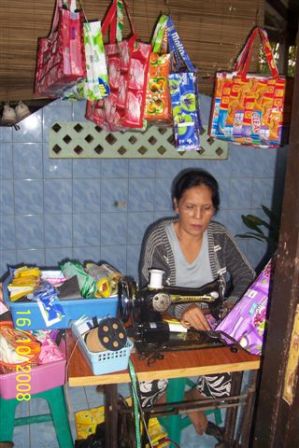 Mrs Theodora is recycling plastic packaging and Five Talents is helping our partner GERHATI in Indonesia recycle supporter’s donations.
Mrs Theodora supports her husband and three children with the money that she makes from collecting plastic packaging and using it to make handbags, purses and cosmetic bags.
Once Mrs Theodora sold diamond jewellery – she did not know how to manage her finances and lived a life of excess. The jewellery business went bankrupt. However, with the help of GERHATI, Mrs Theodora received business training and learnt how to make her recycled plastic bags. Her new business has been a success. She has now taken out and repaid 9 loans and is currently on her 10th loan of £93 from GERHATI which she has used to start and develop her new business.
Despite the hardship of the failure of her first business, Mrs Theodora feels blessed. Until this difficulty in her life she felt that her existence was spiritually empty. However, when she was in need she was able to look to God for love and support.
Rose Chiloletti – Mama Bahati Foundation, Iringa, Tanzania
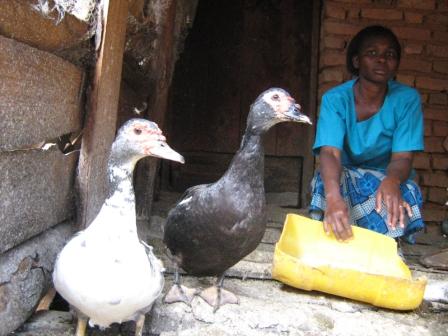 Rose, 46, is married with four children, lives within Iringa Municipality and is a member of Mothers’ Union (MU). Her husband is currently studying, which leaves Rose as the primary supporter of her family. She sells sunflower oil and keeps local chickens and ducks, which she then sells to food vendors and local restaurants near her home.
Joining the Five Talents partner in Tanzania, the Mama Bahati Foundation (MBF), has produced a plethora of benefits for Rose, many of which transcend the economic gains through her connection to MBF. Financially speaking, MBF has helped Rose to increase her capital and widen her poultry market, as her clientele has expanded to include fellow MBF clients. She has managed to motivate and encourage more MU members to join MBF. Rose’s confidence has improved and she has managed to pay part of her children’s school fees. Furthermore, by serving her community with eggs and poultry, Rose enables others to have more balanced meals
Her children have been playing an important role in the marketing of her chickens to their neighbours. This enables Rose to do other activities, knowing that they can manage parts of the business. She intends to teach her children how to become better entrepreneurs, enabling them to surpass her own business abilities. She feels confident that her children are learning from her experience, proving the cyclical nature of empowerment through MBF and micro lending.
David & Anastasia Mwaura - Thika, Kenya
 David and Anastasia have two children. He is a member of Kairi Trust Group (one of the 24 ‘trust groups’ in and around Thika town), where he has been a regular saver and has been able to accumulate savings. So far he has taken two successful loans, with the first loan of Kshs 40,000 (£328) was used to expand his poultry farming business by adding more birds and buying feeds.
His second loan of Kshs 100,000 (£821) was also used for business expansion. David now has a flock of 300 birds which produce 8 trays of eggs every day enabling David to make Kshs 1680 (£13.80) a day.
Anastasia Wambui, David’s wife is a teacher by profession and has quit her job due to her passion for farming and has joined her husband in the poultry keeping business. Their children are both in school and they comfortably pay fees for them, meet their basic needs, save for the future and also plough back some of the profit back to the business.
Beatrice - Nairobi, Kenya

Beatrice moved to Nairobi believing that she would have a better future in the city but experienced greater hardship there. She sold home-brewed alcohol in order to support her children. Beatrice took out her first loan from Jamii Bora Trust of 2,000 KSh (£14.65) to buy vegetables to sell at local markets. She was soon able to pay back her loan and expand her business further.
Beatrice has gone from a small scale vegetable seller to a wholesale seller of soda drinks. She told a visiting delegation of British MPs in 2006 that she no longer considers herself to be poor since she can afford food, clothes and an education for her children.
Beatrice is now on her fourth loan with Jamii Bora which has enabled her to send one of her children to secondary school and another to college for vocational training. It has also enabled her to learn how to read and write. Her dream is to buy one of the new houses being developed by Jamii Bora with a housing loan so that she no longer has to rent.
Keziah - Nairobi, Kenya

Keziah is 82 years old and the oldest member of Jamii Bora. She was a former Mau Mau freedom fighter and told the UK delegation that she was one of the poorest of the poor who was forgotten about when Kenya gained independence. Like Joyce (below) Keziah moved to Nairobi and tried to grow her own food by cultivating food on roadsides.
Keziah became the leader of a women’s group which began to explore how they could improve their future. The group invited Ingrid Munro to talk to their group and through her learned the importance of loans and paying them back and helped to start Jamii Bora.
Keziah’s first loan of 5,000 KSh was used to start up a video hall in the slum area that she lived in. She later, took out a second loan in order to buy a generator so that she could show films even during power cuts. Further loans have enabled Keziah to buy and develop a plot of land for her children and grandchildren; to buy a VW Beetle and to provide her children with educations. Further loans have enabled Keziah to buy and develop a plot of land for her children and grandchildren; to buy a VW Beetle and to provide her children with educations. When the UK delegation met her, Keziah was loan free but thinking about what her next business venture might be.
Beatrice - Nairobi, Kenya

Beatrice lives in the Mathare district of Nairobi but originally comes from the Rift Valley province. Her husband died many years ago leaving her to bring up her 8 children alone. HIV has killed all of her children except for one daughter who ran away from Mathare and one daughter-in-law. She is now the sole carer of her 12 grandchildren.
Beatrice told the UK delegation that she had no one to share her problems with and felt so desperate that she considered killing the children, and then herself, with rat poison. She was too poor however even to buy the poison. A lady called Hanna introduced Beatrice to Ingrid Munro - the founder of Jamii Bora who gave her food…and hope. Beatrice took out a loan of 2,000 KSh and started selling vegetables. Gradually her life started to change and she began to pay back her loans and increase her savings. She said that JBT has helped her to shed many problems and to regain her youth. She has taken out further loans totalling 180,000 KSh (£1,320) to build a permanent home for her family. Her home has 14 rooms of which she rents out 10 to raise enough income to repay her loan. In addition to being a landlady, Beatrice now runs 5 other businesses: a butchers; restaurant; hairdressers, shop and selling water. Two of her children have completed secondary and four more are in high school. Beatrice has told all of her children that they must work hard so that they can support themselves in the future.
Joyce - Nairobi, Kenya

Joyce moved to Nairobi with her children in 1992 after being displaced by tribal clashes in the Rift Valley. She left her home and animals behind so started cultivating land on roadsides in Nairobi to grow her own food. Joyce also started working for other people e.g. washing their clothes but the 900 shillings (£6.60) that she was earning each week was still not enough to support her family.
Joyce was introduced to Jamii Bora and the concept of saving 50 KSh a week. She eventually saved 3,000 KSh and took out a loan to start a small restaurant. She carried on saving and took out larger loans to start another restaurant and a video hall. With her profits, Joyce has gone on to open more businesses and expand her restaurants. She is able to employ more than 60 people, including her three sons who were trained with loans from Jamii Bora, and is therefore helping others to improve their lives too. Joyce is now on her 9th loan with Jamii Bora. “You’re no longer looking at a poor woman!” she told the UK delegation.
If you would like to share the stories of some of the clients your organisation is working with please contact the APPG co-ordinator here.