

News
22nd January 2013 - APPG Co-Chair Lord Boateng Hosts Launch of 'Banking on Change' Report
APPG Co-Chair Lord Boateng hosted a breakfast event in the House of Lords, bringing together representatives of Plan, CARE and Barclays (who collectively consitute the Banking on Change Partnership), as well as other interested parties.
Lord Boateng chaired a lively debate involving representatives of DFID, the CDC and the Banking on Change Partnership, and the Partners used the occasion to announce that their programme of work on financial inclusion has been renewed for a further three years.
For further details of the event, please see coverage on the RESULTS UK blog.
****
31st October 2012 - APPG on Microfinance Celebrates 10 Years
APPG Founder and Chair Annette Brooke MP was joined by Stephen Lloyd MP and other distinguished guests in the House of Commons' Churchill Dining Room this evening for a reception to celebrate the 10th Anniversary of the APPG. For further details, please see the report in the Events and Meetings section.
****
10th August 2012 - Statement from the APPG Microfinance Expressing Deep Concern Over Grameen Bank Governance Changes
The Officers of the All Party Parliamentary Group on Microfinance have issued the following statement:
"As UK Parliamentarians with a special interest in microfinance, we have watched with
interest as the Grameen Bank has grown from humble beginnings to the world-leading
organization that it is today. It is inspiring to see how the organization has maintained its focus on poverty alleviation throughout that time, in part because of the essential governance role of the shareholders of the bank, the people of Bangladesh.
We are particularly impressed with the way that the exemplary nature of Grameen’s
governance structure gives a voice to the too often voiceless. This is Bangladesh leading the rest of the world.
As Prime Minister Sheikh Hasina arrives in the UK this weekend, we would like to express
deep concern at recent changes proposed to those governance structures that threaten that voice.
We are watching developments at the Grameen Bank closely, and hope that the Bank will remain owned and directed by its members through their continued and meaningful participation in the Bank’s governance, so that Bangladesh can continue to inspire other countries with its commitment to that empowerment."
****
3 August 2012 - APPG issues Call for Written Evidence on the Regulation and Supervision of Microfinance
The APPG has launched a consultation on the subject of microfinance regulation and supervision, and we would like to hear the views of individuals and organisations on this topic.
In 2011 we held a 7-month parliamentary Inquiry looking at the role of microfinance in the fight against poverty, and what donors such as the UK Government should do to support the sector. The inquiry culminated in the report ‘Helping or Hurting: what role for microfinance in the fight against poverty’, which highlighted several areas as warranting further study and consideration. One of the most significant of these was the question of how to effectively regulate microfinance in developing countries, and this is something we are now investigating further.
Around the world, governments and financial regulators have developed vastly different frameworks for overseeing the microfinance sector, and the APPG is currently soliciting written submissions in order to help us improve our understanding of how microfinance can be effectively regulated to improve its impact on poverty. We would be interested in hearing from practitioners, academics, financial regulators or any other individuals or organisations interested in microfinance regulation. As usual, the APPG is particularly interested in hearing from respondents who are able to share practical experience and/or original research.
To download the Call for Evidence document, please click here. If you would like to submit a response, please do so by the 27th of August. All written submissions received before the deadline will be considered, and will be used to inform a briefing for parliamentarians and to set the agenda for a meeting of the APPG later this year. If you have any questions or comments regarding the Call for Evidence, please contact the APPG Secretariat at [email protected].
****
3 November 2011 - Official response to APPG inquiry report published
The Government has provided an 'official-level response' to the APPG's inquiry report 'Helping or Hurting: what role for microfinance in the fight against poverty?' The response thanks the group for 'a clear, concise and insightful report on the role UK’s role in supporting microfinance worldwide' and provides responses to each of the report's main recommendations.
Highlights include:
- 'DFID agrees with the report’s recommendation that regulation should offer sufficient protection to consumers but encourages innovation and provides the widest possible service coverage at the lowest risk to the public. DFID’s financial sector programmes provide technical assistance where needed to governments and regulators to develop effective regulation.'
- DFID 'Initiatives to expand access to financial services for the poor must demonstrate how higher rates of financial inclusion will lead to improved social outcomes. The new Skills and Innovation for Micro Banking in Africa (SIMBA) programme [a capacity-building programme for microfinance in Africa] will require all recipients of funding to report on progress against agreed social performance indicators.'
- 'The report’s recommendation for a multi-disciplinary approach to developing innovative micro insurance and savings products working with practitioners in climate change, environment, health and education is pertinent and noted.'
- 'Increasing access to financial services is only one dimension of creating new wealth creation opportunities for poor people. DFID supports the development of inclusive business models, which allow poor people to participate in the value chains of national and international companies as producers, suppliers, employees and consumers...DFID also recognises the important role of small and medium sized enterprises (SMEs) in supporting wealth and job creation in developing countries. DFID is developing new programmes to catalyse a scale up in SME financing in poorer countries.'
The full response can be read here.
The APPG is grateful to DFID for providing this comprehensive response. We particularly welcome the news that the new SIMBA programme will require recipients of funding to report against social performance indicators, which was not only a recommendation in our inquiry report, but also the focus of an APPG meeting in December 2009.
The APPG plans to hold an adjournment debate in Parliament to further discuss the report findings and the Government response. More details will be available shortly.
****
6 July 2011 - Government acknowledges APPG inquiry report
Annette Brooke MP, Chair of the APPG on Microfinance, has received a letter from Alan Duncan MP, Minister of State for International Development, acknowledging the APPG's 'extensive parliamentary inquiry' and 'comprehensive report'. The inquiry, which was launched in November 2010, examined written and oral evidence from a range of stakeholders across the microfinance sector, culminating in a report which was launched at an event in the House of Commons on 8 June 2011.
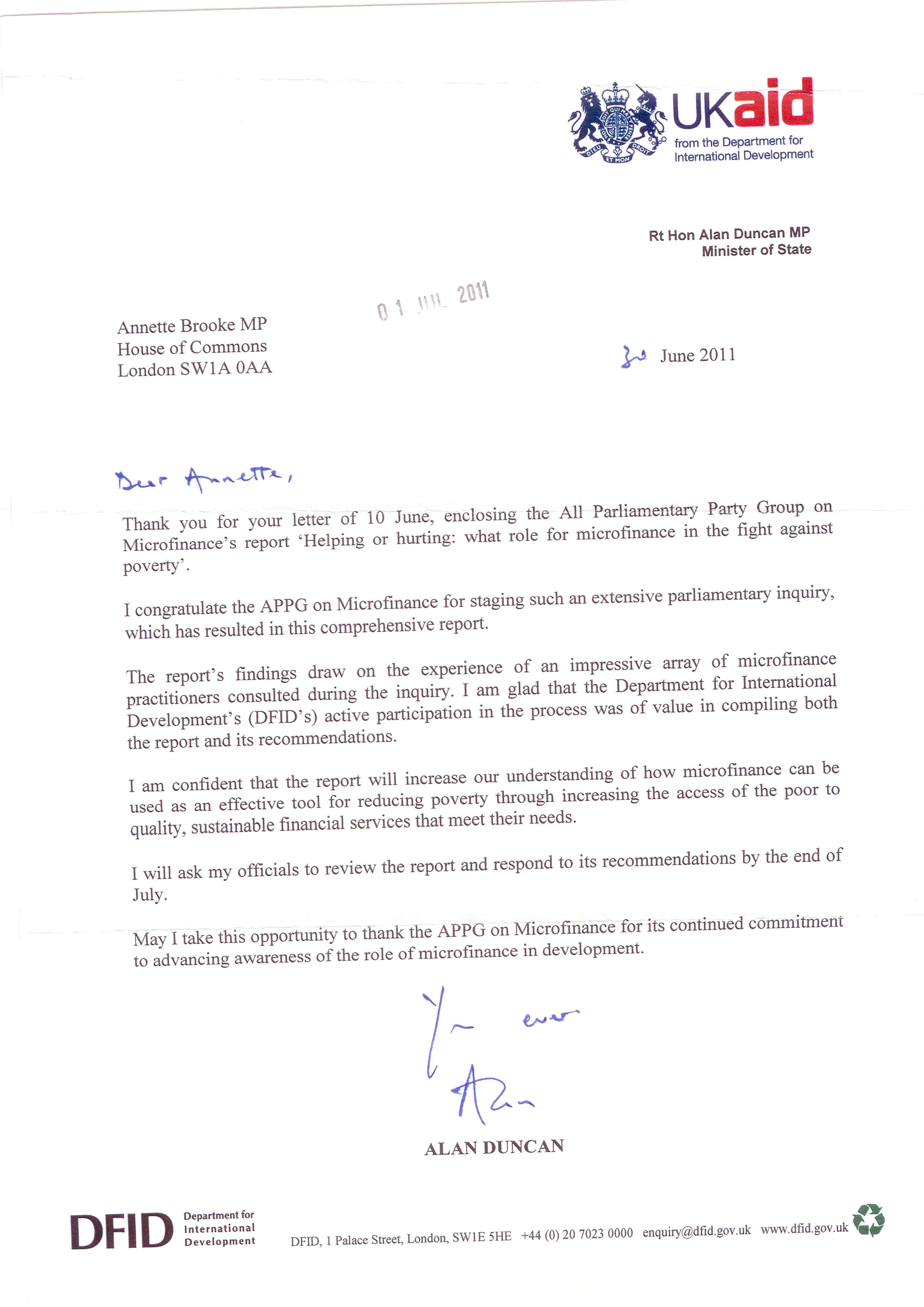
In the letter Mr Duncan pledges that the Government will respond to the recommendations contained in the report by the end of July. This is excellent news, and we look forward to sharing the Government's response once we receive it.
****
12 October 2010 - Debating Microfinance. Article by Annette Brooke MP
Microfinance has been hailed as an effective and sustainable tool to combat poverty, particularly in the developing world. People living in poverty, like everyone else, need a diverse range of financial services to run their businesses, build assets, smooth consumption, and manage risks. However, almost 3 billion people do not have access to formal financial services and instead rely on irregular and unreliable sources of income.
Microfinance offers poor people access to basic financial services such as loans, savings, money transfer services and insurance. Without access to these products, the poor remain vulnerable to shocks. An unexpected household expenditure, large hospital bill or a failed harvest due to adverse weather conditions can push a family further down the poverty ladder if they are not adequately prepared. The inability to accrue savings, build assets and invest in income generating activities can greatly restrict a family’s ability to invest in the things that we take for granted such as healthcare and education.
In my role as Chair of the All-Party Parliamentary Group on Microfinance, I have had the privilege to meet microfinance clients – predominantly women – in Africa and Asia, who have successfully used microfinance to start small enterprises and increase their access to essential services for their family such as health and education. I will never forget meeting a woman in Bangladesh who had used microcredit loans to buy goats and start up a small milk-selling business. She told me how access to microfinance had enabled her to build up assets and a regular income as well as develop business skills through the financial literacy training provided by the microfinance organisation. She then introduced me to her son who had just that week graduated from university. It was thanks to his mother’s entrepreneurial talents that enough money had been saved up over the years to pay for his education. He said he was hoping to become a doctor and earn enough money to allow his mother to retire!
Lack of access to quality financial services is also a barrier to wider economic growth, private sector development and poverty reduction in many countries. Whilst by no means the sole solution to ending poverty, microfinance has a role to play in contributing towards the achievement of all of the Millennium Development Goals, particularly those relating to eradicating hunger and poverty and the empowerment of women.
Whilst it is clear to me that microfinance has made a life-changing difference for the women and families that I have met, there are an increasing number of critics who question the long-term benefits of microfinance. Robust evidence of a wider impact on poverty alleviation is in short supply leading some to ask whether the merits of microfinance have been oversold. Supporters of microfinance are being increasingly forced to come to its defense.
One of the primary functions of the All-Party Group on Microfinance is to provide a platform for debate and discussion on issues relating to microfinance. Next Tuesday [19 October], I will be chairing a debate in the House of Commons that will discuss the pertinent question of whether microfinance is an effective tool for helping to eradicate poverty or not. A panel of eminent speakers will argue for and against the motion, including Dr Milford Bateman from the Overseas Development Institute and author of Why Doesn’t Microfinance Work, Malcolm Harper, Emeritus Professor from the Cranfield School of Management and Dr Martin Greeley, Research Fellow at the Institute for Development Studies.
For our Microfinance group to continue to be effective at raising the profile of microfinance in Parliament, it is essential that we know both sides of the argument. As well as highlighting the positive examples of microfinance clients who have worked their way out of poverty, we need to know how the UK government can support microfinance providers to be more effective at reaching the poor and demonstrating their impact.
I hope that our upcoming debate will mark a key moment in the microfinance dialogue and provide food for thought for both microfinance advocates and critics alike.
Annette Brooke is the MP for Mid Dorset and North Poole. She has chaired the All-Party Parliamentary Group on Microfinance since its establishment in 2002 and runs her own microfinance charity to help students in the UK help students in the developing world.
****
6 July 2010 - Annette Brooke MP re-elected as Chair of the APPG on Microfinance
Annette Brooke, MP for Mid Dorset and North Poole has today been re-elected as the Chair of the All Party-Parliamentary Group (APPG) on Microfinance.
Annette Brooke founded the APPG on Microfinance in 2002 after having been introduced to the issue by a local constituent. The Group has grown to become a leading forum for Parliamentarians, practitioners, academics and non-governmental organisations interested in microfinance.
The APPG was instrumental in supporting the UK National Committee for the UN International Year of Microcredit in 2005 and was one of the sponsors for Professor Muhammad Yunus to receive the Nobel Peace Prize in 2006.
In accepting the post, Annette Brooke said,
"I am delighted that the APPG on Microfinance continues to have the cross-party support of so many politicians as well as from many leading British organisations and academics. Working together we will be able to raise even greater awareness of this powerful type of development which enables individuals, families and communities in developing countries to help themselves and work their way out of lifelong poverty.
“Almost 3 billion people worldwide do not have access to formal financial services and instead rely on irregular and unreliable sources of income. The UK has an important role to play in helping more people gain access to financial services as well as monitoring the social impact of microfinance on its clients.
“Whilst by no means a silver bullet, effective microfinance programmes can contribute towards the achievement of all of the Millennium Development Goals (MDGs), particularly those relating to eradicating hunger and poverty and the empowerment of women. The UN MDG Summit in September is a key opportunity for the international community to review the progress that has been made in eradicating extreme poverty and the role that microfinance can play in helping poor people help themselves.”
Other Members of Parliament were also elected as Officers of the APPG today:
* Vice Chair: Kerry McCarthy, MP for Bristol East
* Secretary: Stephen Lloyd, MP for Eastbourne and Willingdon
* Treasurer: Robert Syms, MP for Poole
****
21 June 2010 - APPG invites input into workplan for 2010 and 2011
The All-Party Parliamentary Group on Mirofinance is looking for input from external stakeholders to help it develop its priorities for 2010 and 2011.
By participating in this short survey, you can help inform APPG members about the direction the group should take and priority issues that it should be addressing.
To participate in the survey, click here.
****
8 June 2010 - Canadian Parliament passes motion to increase support for microfinance
Yesterday a motion calling on the Canadian government to dedicate new funding for microcredit lending in the world’s poorest countries received unanimous support from all Canadian Members of Parliament.
John McCallum, the Member of Parliament for Markham-Unionville, sponsored the motion following a recent visit to a Microcredit Summit in Nairobi, Kenya where he witnessed firsthand how microloans are helping improve communities, giving hope and reaching the very poor (those who live on less than a $1.25/day) people in the world.
“While in Nairobi I met with people who have championed microcredit for years, but it was as I spoke with the locals who have benefited from microloans, I came to appreciate the true potential of this approach to international development,” said McCallum. “When I returned to Ottawa and began discussing my experiences with my parliamentary colleagues I quickly realized that this was something that we could all agree on.”
The unanimous motion read as follows:
That, in the opinion of the House the government should consider providing additional funding, within the next twelve months, to competent organizations for the purpose of carrying out microcredit lending targeted at people living on less than $1.25 per day in least-developed countries.
Click here for the full press release.
****
28 May 2010 - DFID funding has helped 'spur a micro-financial revolution'
In a letter to the Telegraph, Secretary of State for International Development, Andrew Mitchell MP said that well-spent aid can save millions of lives. Mr Mitchell used the example of microfinance to illustrate the positive impact of aid: "DFID's seed-funding for mobile-phone based cash transfers, in partnership with Vodafone, has helped spur a micro-financial revolution across Africa", he said.
****
24 May 2010 - DFID co-sponsors summit on mobile banking
The GSMA Mobile Money Summit, co-sponsored by DFID, Visa, Citibank and others, is currently taking place in Rio de Janeiro. The annual summit brings together mobile operators, finance institutions, and mobile money technology providers to look at news ways to both develop the market for businesses and provide greater access to mobile money services to the "unbanked" populations of the developing world.
****
11 March 2010 - DFID partners with the World Bank to expand mobile banking for the unbanked
The Consultative Group to Assist the Poor (CGAP) the independent microfinance policy and research centre based at the World Bank – has launched a new partnership with DFID. DFID will be co-funding the CGAP Technology Programme along with the Bill and Melinda Gates Foundation, by providing £8 million to the project.
The CGAP Technology Programme focuses on promoting the use of information and communication technologies (ICT) in order to increase access to financial services for a greater number of poor people.
****
26 January 2010 - Mark Field MP leads debate on microfinance in Parliament
APPG member Mark Field MP led a 90 minute debate on microfinance in Westminster Hall today. Also participating in the debate was APPG Chair Annette Brooke MP as well as International Development Spokespeople from the Conservative, Labour and Liberal Democrat parties. Click here to read a transcript of the debate.